The state issued 83,000 village cooperatives in an instant. The president imagined tens of thousands of broomsticks bound into one. This report reads every last record, one by one. More than 82 million data entries: the deeds that legalised them, the land prepared, the assets procured, the officers registered, the outlets built, the coordinates mapped, and the field surveyors' notes.
Aqwam F Hanifan, Betty Herlina
It Began With a Single Broomstick
In the village of Duwet, Panarukan sub-district, Situbondo regency, there is a 932-square-metre plot of village land. The land has no certificate. On it, according to plan, a Merah Putih village cooperative would stand.
On 11 June 2025, a decree bearing an AHU number declared the Duwet Merah Putih Village Cooperative legally established, with 40 people registered as its members. That decree was one of 2,695 issued that day.
Cooperatives like Duwet were designed to be the single economic office of the village: buying villagers' harvests at government-set prices, selling subsidised staple goods, and distributing state assistance programmes. To begin, each cooperative was entitled to a 3 billion rupiah loan from a state-owned bank, with interest covered by the state budget and a six-year term.
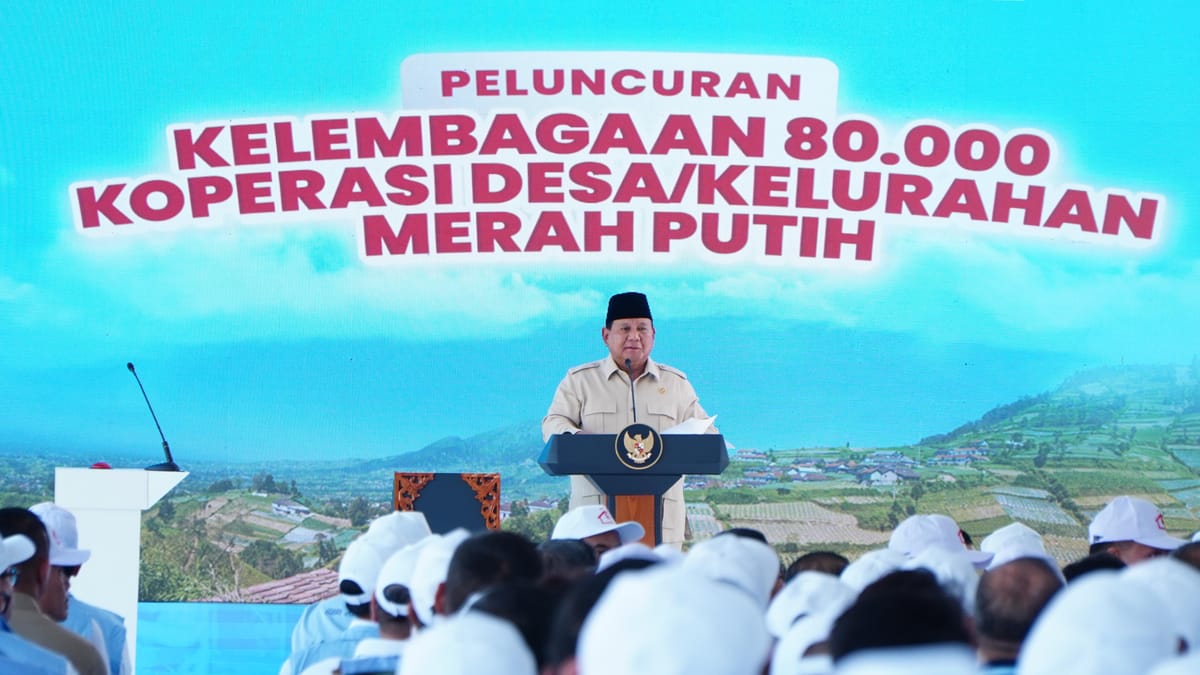
Six weeks after Duwet's decree was issued, in the village of Bentangan, Klaten regency, a stage was erected in the yard of a village cooperative barely a month old. Across the stage stood the logos of 20 ministries and agencies. In front of it sat hundreds of men in white caps. The backdrop banner carried a single sentence with a round number at its centre: LAUNCH OF 80,000 MERAH PUTIH VILLAGE/URBAN-WARD COOPERATIVES.
President Prabowo Subianto took the podium and reached for a metaphor Indonesians had been using long before he was born.
A single broomstick is weak, but if dozens and hundreds of broomsticks are made into one, it becomes strong. That is the concept of a cooperative.
Then he pressed the siren button.
The institutional launch of 80,081 Merah Putih Village/Urban-Ward Cooperatives, 21 July 2025. Photo: National Food Agency.
At that second, 80,081 cooperative legal entities were declared established, one for nearly every village and urban ward in Indonesia. Duwet was one of them.
A year later, in the transactions column of the Duwet Village Cooperative, the figure was still zero.
And yet, next month, the first instalment of that three-billion-rupiah loan falls due. This is the tale of the 83,000 broomsticks Prabowo spoke of.
How this report was built
The programme has its own information system: SIMKOPDES, a database managed by the Ministry of Cooperatives. It provides maps, statistics, and a profile page for every village cooperative. All of it can be opened without a password.
For this report, the cooperative profiles were read one by one, then assembled into a single table. One row represents one cooperative; the columns hold, among other things, the legal-entity date, members, land, outlets, transactions, and site conditions. From that table the patterns of the entire programme can be calculated, rather than glimpsed through a handful of examples.
Collection was carried out through the same service the public website uses. No password was broken, no security flaw exploited, no closed system entered. Requests were sent one at a time, with pauses, so as not to burden the server.
The detailed cooperative data was pulled on 18 July 2026, re-checked on 9 August, and then each cooperative's page was collected once more on 11 August. The technical notes and the limits of the data appear at the end of this report.
A presidential instruction in early 2025 ordered the formation of a cooperative in every village and urban ward. The target was 83,595 units. A follow-up instruction, Number 17 of 2025, governed the acceleration of their outlets and warehouses. The Ministry of Public Works issued a ministerial decree containing the building prototype, so that the 83,000 structures would be uniform.
Indonesia has done something like this before. Village Unit Cooperatives were built throughout the New Order, propped up by a fertiliser monopoly and state rice purchases, and took years to spread. The Merah Putih village cooperatives spread in under two years.
A wall, not a curve
The founding date of a cooperative is recorded in the legal-entity administration system of the Ministry of Law. Of the 83,345 cooperatives whose profiles were read for this report, 65,908 carry that date. The remaining 17,437 cooperatives list nothing at all in that column, and that in itself is a finding: a fifth of the programme has no birth date legible from its own database.
Village cooperative legal entities issued per day
April to August 2025
Source: decree dates on 65,908 deeds in the SIMKOPDES database, pulled 9 August 2026.
Among the 65,908 that are recorded, the shape is not a curve.
May 2025: 10,322 legal entities issued. June 2025: 50,960. July 2025: 3,396. Then over the following 12 months, August 2025 to July 2026, only 1,173 more were added, an average of 98 a month.
Before May 2025, only 38 Merah Putih village cooperatives were registered. Some were dated 2014.
The busiest day was 12 June 2025, with 2,949 legal entities issued in a single day. Spread evenly across 24 hours, that means two legal entities born every minute, day and night. The 10 busiest days all fell in June, all above 2,300 decrees.
Founding a cooperative requires a notarial deed. A notary does not merely type. They confirm the founders are real, that the meeting truly took place, that the members exist, that the capital is clear. Every deed demands attendance, a reading, and signatures.
In June 2025, that work had to be done 50,960 times in 30 days. How many notaries did it, and how the work was divided, could not be found in official documents or in any public statement traced for this report. The question was put in writing to the Directorate General of General Legal Administration and had not been answered by the time this report was published.
Village cooperatives did not grow slowly from village to village. The state chased a target of tens of thousands of cooperatives within weeks, then issued them almost simultaneously.
A system that records results, not process
The Ministry of Cooperatives keeps its own database, separate from the Ministry of Law's legal-entity system. In SIMKOPDES, the founding of a cooperative is divided into three stages: "Registration", "Processed by Notary", and "Completed". Each stage carries a timestamp down to the second.
If those stamps recorded the founding process, the order should be simple: registration happens first, the notary processes the file, and then the cooperative is declared complete.
Yet for 79,502 cooperatives—about 95 per cent—the "Processed by Notary" and "Completed" stages are recorded in the system as having occurred in the very same second.
To check this, those timestamps were compared with the dates of the legal-entity decrees from the Directorate General of General Legal Administration. The decree marks when a cooperative officially came into being.
For 56,162 cooperatives, the "Completed" stage was only entered after the decree was issued. Of those, 48,208 lagged by one to seven days. Delay in updating a status is still plausible in administrative work. But the same pattern appears at the earliest stage.
Stages recorded after the fact
Where the "Completed" timestamp in the Cooperatives Ministry system sits relative to the decree date from the Directorate General of General Legal Administration
Of the 65,908 cooperatives whose two dates can be compared, 56,162 were stamped after the decree was issued and 48,208 of those lagged by one to seven days.
For 38,775 cooperatives, "Registration" was only recorded after the legal entity had been issued. The system places the start of the process after the process had finished.
The Duwet cooperative in Panarukan, Situbondo, is one example. Its legal-entity decree was issued on 11 June 2025. The "Processed by Notary" and "Completed" stages were only entered on 13 June at 04:48:56—two days later, in the same second.
Those stamps are better read as the time an officer filled in the system, not the time the events took place. Two stages can be entered at once after all the legal business is done.
In a programme that produced more than 50,000 legal entities in a single month, the record of the process is precisely the part that is missing. The state can show when the final results were issued. SIMKOPDES cannot show how all of it was done that fast.
What Stands and What Is Not Ready
Illustration created with the help of artificial intelligence. Not a photograph of an actual location.
All 83,378 cooperatives in the database already hold legal-entity status. On paper, every one of them exists. The moment their physical readiness is examined, they split into five groups.
The top group holds 32,728 cooperatives recording at least one outlet. Next come 16,358 cooperatives with verified land but no building yet. For 9,959 cooperatives, the land is still only a proposal. Another 6,843 are recorded as having no land at all.
At the very bottom sit 17,490 cooperatives that have nothing but legal-entity status. They have recorded no outlet, no verified land, and no plot under proposal. The state has recognised their existence, but they have nowhere to build an outlet.
Five wildly uneven piles
83,378 cooperatives by how far each has come, as of 11 August 2026
Compare all those piles with one official figure: in June 2026, the number of cooperatives genuinely operating was 1,061. The gap between the 32,728 with an outlet and the 1,061 that are operating is the gap between a building and a business.
In other words, of the 83,378 cooperatives legally established, 50,650 have no outlet on record. That is more than six in every 10 cooperatives. And 34,292 have not even reached the stage of holding verified land.
The programme moves at two speeds. Its legal entities were issued tens of thousands at a time within weeks. After that, each village still has to find land, confirm who owns it, agree on a location, pass verification, and wait for construction.
The cooperatives were born all at once. Their places of business were not.
All 83,378 Merah Putih village cooperative points
Filter by how far each cooperative has come, then narrow down to province and regency. Loads on scroll.
Official coordinates for each cooperative from the SIMKOPDES microsites, pulled 11 August 2026; outlet and land status from the programme database, 9 August 2026. Points mark the coordinates a cooperative recorded, not a building that stands. Imagery: Esri, Maxar, Earthstar Geographics.
The buildings that leave people puzzled
On 4 August 2026, Fauzan uploaded a short video to Instagram. The text on screen read: Want to see how far this KOPDES at the foot of Mount Ciremai is from any house?
The camera first faced the still-new cooperative building. Its roof was striped red and white, its rolling door still smooth. When the camera turned, all that could be seen was gravel and bare earth. There were no houses around it.
The video was liked 682,000 times and drew 103,000 comments.
The building at the foot of Ciremai is not the only one. At the Antang landfill in Makassar, a cooperative outlet stands a few metres from a rubbish heap. In Banten, another was built on a former sulphur mud pit, on long-idle village treasury land later chosen through a village assembly. Another appeared in the middle of rice fields, facing a graveyard.
Those videos spread not because people were angry, but because they were puzzled to see a shop built where perhaps no one would ever come.
Cooperatives Minister Ferry Juliantono said complaints about unstrategic locations numbered fewer than ten, against the tens of thousands of village cooperatives built across Indonesia.
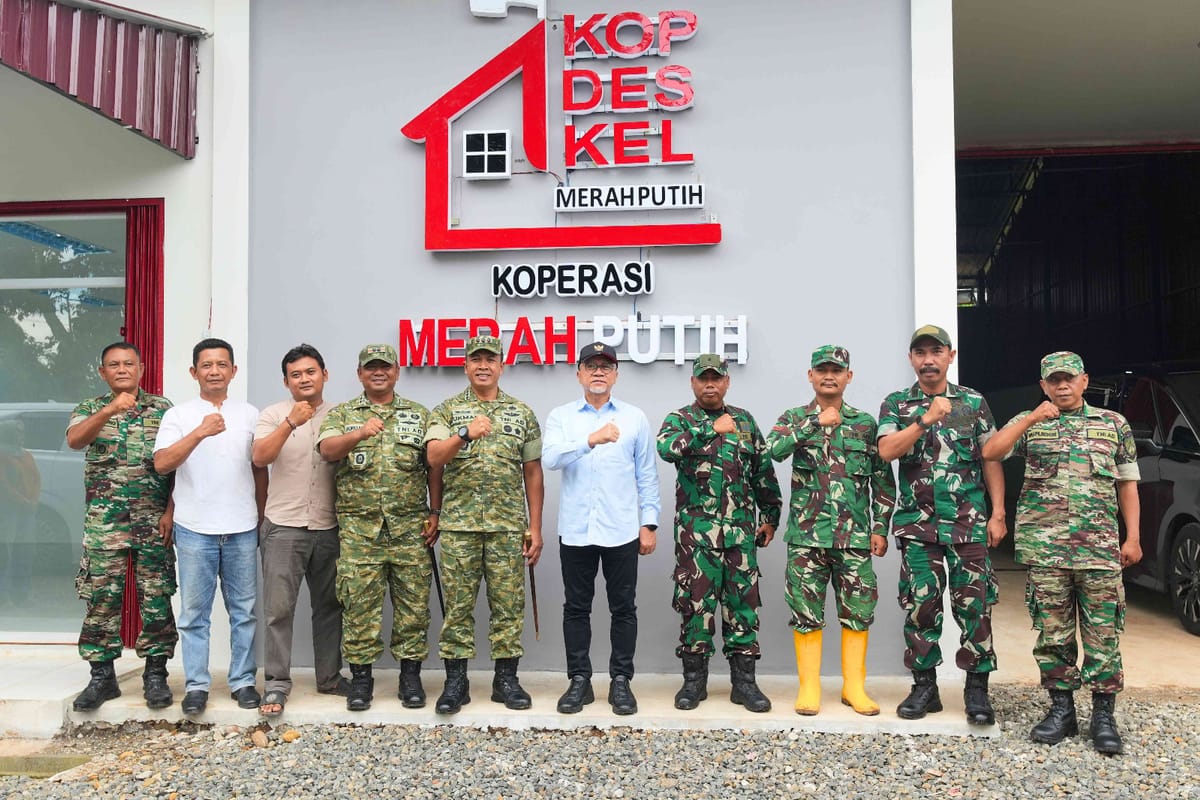
Zulkifli Hasan in front of a Merah Putih village cooperative outlet. Photo: Ministry of Cooperatives.
Coordinating Minister for Food Zulkifli Hasan said the criticism sprang from a mistaken picture of what the cooperatives are for.
Let me explain, a village cooperative is not a shop, not a supermarket. So there's no need for small stalls, all sorts, retail shops, to worry, this isn't that.
Their function, he said, is to absorb harvests and channel government programmes.
So if a farmer's grain price is only Rp5,000, we set it at Rp6,500, and the cooperative buys. The cooperative buys, how is that not a benefit? It's helping the farmer.
A grain collection warehouse does not, in fact, have to stand in a busy centre. A building far from houses is not necessarily wrong either, if it is close to the fields, reachable by truck, and has electricity, water, and a communications network.
That is why the suitability of a location cannot be judged from a clip on social media. The measure has to be more concrete. For that, Zulkifli Hasan could turn to the notes left by his own programme's surveyors.
What the surveyors wrote
Surveyors fill in a digital form when they visit a prospective cooperative site. Most of the questions are multiple choice: road type, sources of electricity and water, signal strength, and distance to settlements.
At the end of the form is a single empty box. There, an officer can write down conditions that do not fit the available options. Those notes do not appear on a cooperative's public profile page. They sit at the back of the system and only became visible once asset records were collected one by one.
There are 15,301 such notes in the collected data. Of those, 11,210 describe a problem. They were written by people standing on a plot of land, obliged to report what they saw to superiors who were not there.
The language is uneven. There are capital letters left on throughout, missing spaces, and now and then, the tone of someone who knows that what they are reporting makes no sense.
An officer in Situbondo wrote without punctuation:
Hill Terrain Road Access Only Passable On Foot.
A grain collection warehouse, on top of a hill, reachable only on foot. A tonne of grain would have to be carried up and down that hill on someone's shoulders.
In Sepuk Laut, Sungai Kakap sub-district, Kubu Raya regency, the plot measures 80 square metres and the explanation is reason enough to halt construction:
road access to Sepok Laut village is only possible by boat there is no land route. 90% of Sepok Laut's people work as fishermen.
In Taopa Utara, Parigi Moutong, the village land that remained had already been given to the dead. Officials were holding assemblies to persuade residents to move the graves, so the cooperative would have somewhere to stand.
The remaining village land has been granted for the public cemetery. Still awaiting an assembly with the community to obtain their consent for relocating the Public Cemetery.
And from Pulo Gelime in Gayo Lues, Aceh, came one sentence that captures the absurdity of the programme: the village is living in evacuation. The cooperative was issued anyway.
our village is still under total relocation status and residents are currently living in the temporary shelters provided by the government.
What circulated on social media were buildings in the middle of rice fields, in front of graveyards, at the edge of ravines. Inside the survey notes, the word cemetery appears 22 times, rubbish dump 12 times, and steep terrain 199 times.
The most frequent complaint is far more ordinary: the village has no land. Notes of that kind appear 7,945 times. In another 1,630 notes, the available land turns out to belong to the state forestry company or the regional government, or to have been endowed to a mosque.
Ferry Juliantono said his ministry had received fewer than ten complaints about locations. The officers the programme itself sent out left behind 11,210 notes describing problems.
Surveyor notes are reproduced in the original Indonesian, exactly as they were typed into the system.
All 15,301 notes published in full
Including the 11,210 that report a problem. They can be filtered by province, by regency, and by type of complaint, searched word by word, then downloaded. Nothing has been summarised, cherry-picked, or smoothed over.
Before an outlet is built, every village is asked to provide at least 1,000 square metres of land. That land must belong to the state, the village, or come from a grant, and its location must be agreed collectively.
Those conditions sound simple until officers start trying to find the land.
In Sokobanah sub-district, Sampang regency, there are three neighbouring villages: Tamberu Daya, Tamberu Timur, and Tamberu Laok.
All three applied for a Merah Putih village cooperative. All three were stuck at the first step, because they had no land to build on.
That does not mean the three own no land. The surveyors wrote it down one by one, in almost identical sentences.
Tamberu Daya's village land is in another village (Tamberu Barat).
Tamberu Timur's village land is in another village (Tamberu Barat).
Tamberu Laok's village land is in another village (Tamberu Barat).
Three villages own land. All three plots sit in a fourth village.
This is not a recording error. Village treasury land in Java and Madura is often older than the boundary lines that now surround it. It has moved through land swaps, grants, and administrative splits over decades. What was preserved was ownership, not its position inside today's village lines.
An officer in Pasuruan calls it village treasury land. In Sampang it is called pecaton. In Situbondo it is abbreviated TKD. The problem is the same:
The Village Treasury Land (TKD) lies outside the village area or falls within another village's area, and no alternative land is available within the village.
There are 61 cooperatives with notes of this kind. The most cases were found in Sampang and Serang, eight cooperatives each, followed by Situbondo with six and Lumajang with five.
There are 61 cooperatives with notes of this kind. The most cases were found in Sampang and Serang, eight cooperatives each, followed by Situbondo with six and Lumajang with five.
Those field findings were then compared with the village boundary map published by the Geospatial Information Agency in June 2026. That map contains 84,503 village and urban-ward boundary polygons.
A total of 83,158 cooperative coordinates could be tested. The result: 80,253 fall inside the village that matches their registration. The remaining 2,905 units fall outside.
Most miss only narrowly. There are 323 cooperatives whose point sits less than a hundred metres across the line, and 1,334 less than a kilometre away.
At distances that small, no one can say for certain which one shifted, the point or the boundary line.
The Sukoanyar cooperative in Cerme, for instance, maps into Guranganyar village. The Kendaga cooperative in Banjarmangu maps into Kesenet village. Both are only about two hundred metres from the village boundary.
2,905 cooperatives whose point falls outside their own village boundary
Tested against the Geospatial Information Agency's village boundary map. The second tab shows the gap between two coordinates the state holds for the same cooperative. Loads on scroll.
Each point is a cooperative's official coordinate falling outside its own village boundary polygon, coloured by its distance from that boundary. Village boundaries: Geospatial Information Agency village polygon map, June 2026 edition, 84,503 villages and urban wards. On the second tab, lines connect two coordinates the state holds for the same cooperative; the village point is not a survey result, so this measures disagreement between records, not distance to people's homes. Source: Ministry of Cooperatives database. Imagery: Esri, Maxar, Earthstar Geographics.
The errors become harder to explain as the distance widens. A total of 340 cooperatives map more than a hundred kilometres outside the village listed on their profile. And 352 land in another province altogether.
In Papua, the errors come in clusters. Some 24 cooperatives from Highland Papua and 13 from Southwest Papua map into Raja Ampat regency—in Arborek, Yenwaupnor, and Kabilol. Cooperatives from mountain valleys surface in island villages.
Highland Papua records the largest share. Of the 2,387 cooperatives that could be tested in that province, 684 sit outside their village boundaries.
Sixty-one officers have written that their village land lies outside the village. The map shows a far bigger problem: some points merely cross a boundary, but hundreds of others move regency, province, even landscape.
The shop that cannot switch on a light
The programme's survey recorded basic site conditions for 34,368 cooperatives. Most sit on asphalt roads, are connected to the state power grid, and have a strong internet signal. Thousands of others do not.
Site conditions for the 34,368 cooperatives whose survey fields are filled in, as of 9 August 2026. The remaining 48,977 cooperatives have nothing recorded in this column.
A total of 1,239 sites have no electricity connection. Not power that cuts out often: the grid simply does not reach them yet.
Village cooperatives were designed to sell food, medicine, and subsidised goods. Some of those goods need refrigerators or cold storage. At those 1,239 sites, the equipment might be delivered, but there is no electricity to run it.
A total of 1,103 sites have no internet signal. Yet the cooperatives were also designed to distribute assistance, subsidies, payments, and financial services. Staff have to verify identities, match recipients against government databases, process transactions, then submit reports. All of that work depends on an internet connection.
Without a signal, transactions can still be written on paper. To the ministry's system, a record that cannot be transmitted will still look like a transaction that never happened.
Road access is not always better. A total of 428 sites have no road at all. Another 4,806 can only be reached by dirt track.
The government says the cooperatives will chiefly be harvest collectors. But grain, maize, fertiliser, and staples move by truck. When rain turns a dirt track to mud, a loaded vehicle can stop before it reaches the warehouse.
Sites without a road, electricity, signal, or water
Filter by type of shortfall and by province, or narrow to cooperatives whose outlet already stands. Loads on scroll.
Basic site conditions recorded by surveyors, pulled 9 August 2026. One cooperative may lack more than one thing at once, and outlined circles mark those. Points use the cooperative coordinates on the SIMKOPDES microsites, 11 August 2026. Imagery: Esri, Maxar, Earthstar Geographics.
Some sites face several shortfalls at once. A total of 338 cooperatives have no electricity, no water, and no internet signal. Another 428 sit at the end of a dirt track and have no electricity.
At those sites, the question has not yet reached turnover or profit. The outlet does not even have the basic conditions to function.
The same shortfalls are found in buildings that already stand. Of the 32,729 cooperatives recording at least one outlet, only 17,907 list their site conditions.
Among those outlets, 482 stand with no electricity connection. Some 894 have no water, 495 no internet signal, and 179 sit at a site with no road access. There are also 1,844 outlets reachable only by dirt track.
Which is to say, a physical building does not always signal a business ready to run. Some outlets have walls, a roof, and a door, but no electricity to switch on a light.
The limits of that data are also wide. Information on electricity, water, signal, and roads is only available for 34,368 cooperatives—about 41 per cent of the whole programme. Another 48,977 cooperatives list no site conditions at all.
Empty data does not mean all of those sites are troubled. But for nearly six in ten village cooperatives, the government cannot yet show whether the outlet has water, can connect to the internet, can be reached by vehicle, or can simply switch on a light.
Two outlets facing each other
In early March 2026, photographs of two Merah Putih village cooperative buildings circulated on social media. The two stand facing each other on the Wonogiri–Pracimantoro road. Social media users compared them to Indonesia's two big convenience store chains.
The Merah Putih village cooperative outlets of Sindukarto and Sumberharjo villages in Eromoko, Wonogiri, stand facing each other, separated by the Wonogiri–Pracimantoro road. Photo: Radar Solo, Jawa Pos Group.
The buildings belong to two villages in Eromoko sub-district, Wonogiri: Sindukarto and Sumberharjo. The Wonogiri regent said the positioning was a consequence of limited village land. The head of Sindukarto village, Erianto, said the two were never planned to stand facing each other.
The Sindukarto cooperative occupies 1,024 square metres. It records two outlets and 22 people as members, officers, and supervisors. Across the road, the Sumberharjo cooperative stands on 1,500 square metres, recording four outlets and 20 people.
Both plots have been through the programme's process: one verified, one declared complete. Nor are the coordinates wrong. Tested against the village boundary map, each sits within its own territory. The road between the two buildings is also the line that separates the two villages.
The Wonogiri case is not unique. The distance between cooperatives was calculated across all coordinates using three thresholds: 500 metres, one kilometre, and two kilometres.
A cooperative enters a cluster if it has at least one neighbour within that distance. Clusters can form chains. So two cooperatives at opposite ends of the same cluster are not necessarily within the threshold of each other. The calculation also uses straight lines between coordinates, not travel distance by road.
Cooperatives built side by side, at three radiuses
Switch the radius between 500 metres, one kilometre, and two kilometres. Click a cluster to look closer. Loads on scroll.
Clusters are calculated from the distance between coordinates, one point per cooperative. Only clusters holding cooperatives from two or more different villages are counted. Source: Ministry of Cooperatives database, pulled 18 July 2026. Imagery: Esri, Maxar, Earthstar Geographics.
At 500 metres, 1,825 clusters were found, containing 4,685 cooperatives. Widening the distance to one kilometre, the count rises to 5,095 clusters holding 19,123 cooperatives.
At the two-kilometre threshold, 49,536 of the 83,378 cooperatives have at least one other village cooperative nearby. That is 59.4 per cent of the entire programme.
Coordinating Minister for Food Zulkifli Hasan has responded to the prospect of two village cooperatives being built close together.
Say Village A and Village B build near each other, one serves this village, one serves that village. No problem, because a village cooperative is not a supermarket, it is government infrastructure.
Village boundaries do explain why Sindukarto and Sumberharjo each have their own cooperative. Those boundaries do not separate their prospective customers.
Each cooperative may take out a loan of up to Rp3 billion. Each has to earn revenue to pay the instalments. When two outlets stand on the same road offering similar necessities, an administrative line does not stop residents choosing where to shop.
Nor are the two entering empty space. Stalls, grocery shops, and local traders were already looking for customers there.
In Eromoko, that competition was not born of two entrepreneurs who happened to pick nearby sites. The two buildings stand because the state ordered one cooperative for every village. This chaotic competition did not emerge from the market. The government created it.
A Jokowi-era loophole, executed by Prabowo
A cooperative differs from other business entities because its identity rests on its members. A sole proprietorship can be founded by one person. A foundation has no members. A cooperative is people who gather, pool capital, use its services, and elect its officers.
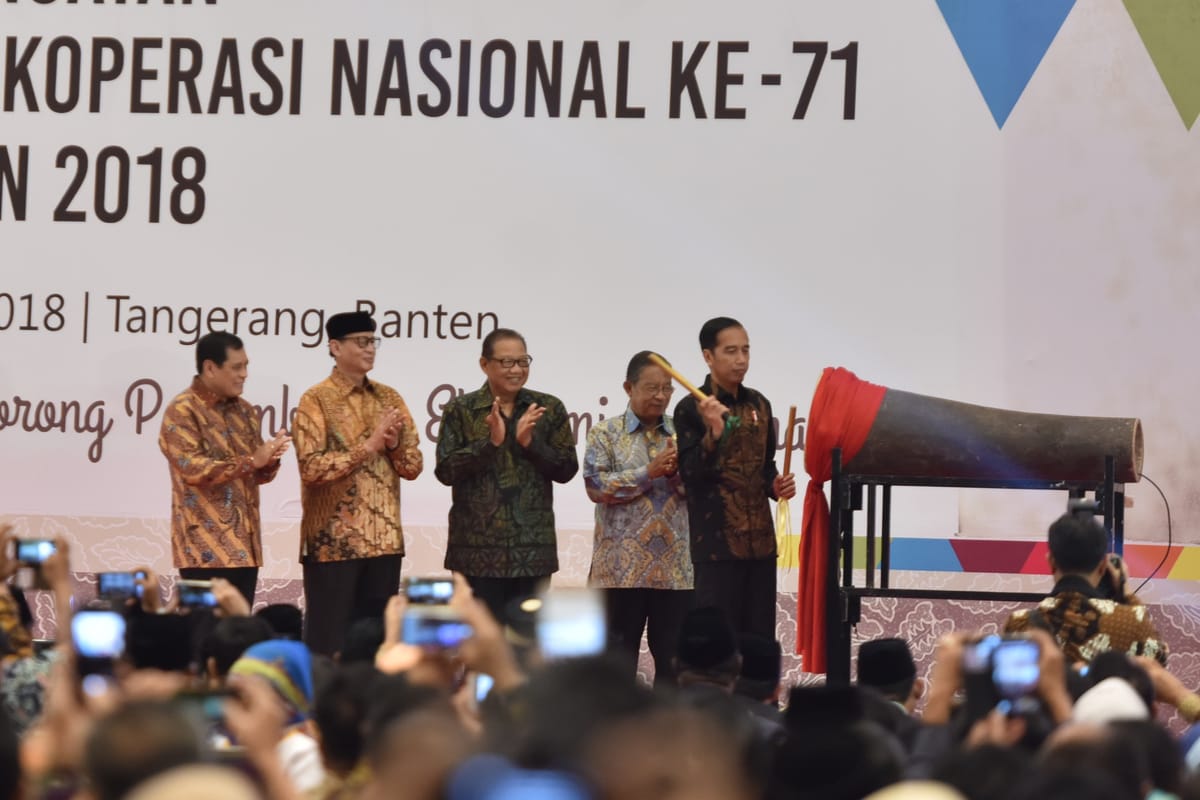
President Joko Widodo at the peak of the 71st National Cooperative Day commemoration in Tangerang, Banten, 12 July 2018. Two years later the Job Creation Law cut the founder requirement for a primary cooperative from twenty people to nine. Photo: Cabinet Secretariat.
In 2020, President Joko Widodo changed the requirements for founding a primary cooperative through the Job Creation Law. The minimum number of founders, set at 20 people since 1992, was cut to nine.
Forming a cooperative has also been made easier, just nine people and a cooperative can already be formed," Jokowi said. "We hope there will be more and more cooperatives across the country.
Purwoko, a lecturer at the Faculty of Economics and Business of Ahmad Dahlan University, criticised it from the start. Between 2016 and 2019, the government had in fact dissolved 81,686 cooperatives that were no longer running. Indonesia, he argued, has no difficulty founding cooperatives. What is difficult is maintaining their quality and keeping the business alive.
"Lowering the founding requirement from 20 people to nine actually reduces the meaning of a cooperative," he wrote in Suara Merdeka.
Five years later, the Prabowo administration used the legal door opened under Jokowi to form Merah Putih village cooperatives en masse.
Those provisions were spelled out in more detail through Cooperatives Ministry Implementing Guideline Number 1 of 2025. The guideline requires at least five officers—a chair, two deputy chairs, a secretary, and a treasurer—plus at least three supervisors.
The two rules together produce a minimum structure that fits almost exactly. The law requires at least nine people to found a cooperative, while the guideline provides eight seats for officers and supervisors. By adding a single ordinary member, a village cooperative can meet the legal-entity requirement and fill its entire basic structure at once.
That pattern is visible in the database. As of 11 August 2026, some 17,368 village cooperatives record only 1–8 unique individuals registered as members, officers, and supervisors combined. That number falls below the founding requirement for a primary cooperative set by law. Which means nearly 21 per cent of village cooperatives are currently in breach of the law.
The government could argue that the ninth member and others exist but have not been entered into the system. That explanation does not settle the matter. Because the state's own database already shows that tens of thousands of village cooperative legal entities cannot meet the most basic membership requirement.
Cooperatives recording eight people or fewer are only the tip of the iceberg. The broader problem is thin membership across nearly the whole programme.
One in five cooperatives records fewer than nine people
Distribution of 83,400 cooperatives by the number of unique officer, supervisor, and member names on their own microsites, 11 August 2026
The law requires at least nine people to found a primary cooperative, while the village cooperative guideline provides eight officer and supervisor seats. The leftmost band is the cooperatives that have not cleared that threshold. At the other end, only 4,081 cooperatives record more than 82 people. Fifteen cooperatives record no name at all and are excluded from the count.
Some 26,312 cooperatives record nine to 14 people, and 19,247 cooperatives record 15 to 28 members. Wider data shows that more than half of the village cooperatives legalised by the Ministry of Law have fewer than 14 members. Only 4,081 cooperatives, or 4.89 per cent, record more than 83 members.
Among cooperatives whose outlets already stand, of 37,228 cooperatives nearly 13,592—36.51 per cent—record fewer than 14 members. And 3,133 village cooperatives have only 1–8 members.
Which means that in more than a third of village cooperatives that already have an outlet, physical construction has run ahead of gathering the members.
Eight people and hectares of land
What complicates matters is not the thin membership registry itself, but what those minimum-membership cooperatives already hold.
In the village of Upang Ceria, Muara Telang, Banyuasin, one village cooperative is recorded as holding 87,500 square metres of land. Nearly nine hectares, about 12 times the size of a football pitch. The land is verified and its legal entity was issued on 13 June 2025. As of the last data pull, not a single business unit had been registered.
The total number of people recorded within it—members, officers, and supervisors combined—is eight.
Upang Ceria is an extreme case. As a rule, cooperatives with eight people or fewer hold 900 square metres of land, slightly below the programme-wide median of 1,000 square metres.
But of the 6,005 cooperatives holding eight people or fewer whose land area is recorded, 108 hold more than one hectare.
108 eight-person cooperatives holding more than one hectare
Colour marks who is recorded as the asset owner. The second tab holds all 744 cooperatives with large landholdings. Loads on scroll.
Land area and the names in the asset-owner column are taken as they are from the Ministry of Cooperatives database, pulled 9 August 2026. Headcount is the number of unique officer, supervisor, and member names on each cooperative's microsite, 11 August 2026. Circle size follows land area. Imagery: Esri, Maxar, Earthstar Geographics.
The Banjar cooperative in Kertek, Wonosobo, is recorded as holding 32,385 verified square metres. The Wates cooperative in Gadingrejo, Pringsewu, holds 29,960 square metres. The Jalatunda cooperative in Mandiraja, Banjarnegara, has 23,150 square metres. All three record eight people and one business unit.
In Sumenep, the same pattern appears across three sub-districts. The Soddara cooperative in Pasongsongan holds 17,106 square metres. The Gedugan cooperative in Giliginting has 16,744 square metres. The Tanjung cooperative in Saronggi is recorded with 16,409 square metres.
Of those 108 small cooperatives with more than a hectare of assets, only 47 name the cooperative itself in the asset-owner column. Some 36 list "Business Assistance", 15 list PT Agrinas Pangan Nusantara, four the Ministry of Home Affairs, and four the armed forces. The Health Ministry and the programme management office appear once each.
The largest asset recorded in the name of the armed forces is in Kwigiluk hamlet, Molagalome district, Jayawijaya, Highland Papua. It measures 60,042 square metres, about six hectares.
The land of the Wates, Jalatunda, Soddara, Gedugan, and Tanjung cooperatives is not recorded in the cooperatives' names. All five list Agrinas as the asset owner.
Eight people can fill every officer and supervisor seat the guideline requires. In this database, that minimum structure then stands on hectares of land—and some of that land is recorded in the name of another institution.
From there the next question follows: when the land comes from the village, the cooperative holds only a handful of people, and the assets are recorded in someone else's name, who actually holds this programme's wealth?
Village land, whose assets?
Building tens of thousands of outlets in a short time requires land that is also available in a short time. It is no surprise that the programme leans heavily on land owned by villages and the government.
The land area recorded in the village cooperative database totals 86,124 hectares, larger than Jakarta. Of that, 31,602 plots are classified as Village Property, 7,098 as Regional Property, 4,555 as granted land, and 1,673 as State Property.
Of the 46,987 cooperatives whose land area is recorded, only 42.4 per cent state that their land is certified. Some 11,725 cooperatives have no land at all, 1,823 of them in Aceh and 1,322 in North Sumatra.
Recorded as asset owner
Recorded as surveyor
The problem grows more complicated when the "asset owner" column is opened. It is unclear what "asset owner" means in this dataset, whether it refers to the land or the building.
The head of public relations at the Ministry of Cooperatives and SMEs, Fitara A. Tito, was also at a loss to answer. "On this matter, I'm sorry, I don't really understand the details either," she said by text message.
What is clear is that 33,888 cooperatives have filled in this asset-owner field. In 18,319 cooperatives, the name entered is PT Agrinas Pangan Nusantara. The name "Business Assistance" appears in 10,347 cooperatives, the Ministry of Health in 1,457, the armed forces in 1,105, and the programme management office in 218.
Agrinas is also the party that recorded the most locations. The company is logged as having surveyed 23,797 assets, more than the cooperatives themselves, which surveyed 18,658.
Who is recorded as the asset owner, 83,340 points
Loads on scroll.
The owner column marks who is recorded as holding the asset, not who owns the land in law. Asset records from the Ministry of Cooperatives database, pulled 9 August 2026; points use the cooperative coordinates on the SIMKOPDES microsites, 11 August 2026. Imagery: Esri, Maxar, Earthstar Geographics.
The state-owned company was indeed assigned to build the outlets, warehouses, and equipment. Agrinas will then accompany their management for two years. After that period, management is said to be handed over to the village government.
The problem lies precisely in the regulatory vacuum after that management period ends: the land comes from the village, the assets are built and recorded in Agrinas's name, but the government promises only a handover of management. Who ultimately owns the outlet and all its equipment has never been explained in detail.
Because in this transfer, it is also unclear who bears the residual value, who records the depreciation, and who is entitled to take it back if a village cooperative ceases operating or defaults on its loan.
Asked for confirmation, Agrinas chief executive Joao Angelo De Sousa Mota denied that Agrinas is recorded as the asset owner in 18,319 records and as surveyor in 23,797. "How would I be the owner, I'm just a builder, assigned to build the cooperatives in line with the cooperation agreement,"
Joao added that his company was indeed asked to accompany management operations during the incubation process, but is not responsible if a cooperative stops operating or fails to repay its loan.
"I'm just a builder. The job is to build; since when does a builder have to answer for everything downstream?" he said.
When Soldiers Teach Cooperative Managers to Trade
The five participants in the Graduates Driving Indonesia's Development programme who died between 17 and 27 June 2026. Illustration.
A programme promising 80,000 village shops also promised 80,000 people to run them. The state did not look for them among traders, veteran cooperative officers, or people who had ever closed the books on a business. It looked among fresh graduates, then sent them to barracks.
On 17 June 2026, some 35,476 people entered basic military training. Nearly 30,000 of them were prospective Merah Putih village cooperative managers. The remaining 5,476 were prospective managers of Merah Putih fishing villages. The programme is called Graduates Driving Indonesia's Development. The training ran until 31 July.
Nothing in the job waiting for them demands combat ability. At the end of the training lies an outlet of a few square metres, shelves to be stocked, a cash book to be closed every month, and a three-billion-rupiah loan to be repaid. Yet the road there runs through six weeks of basic military training.
On the first day, one participant died of cardiac arrest. By 27 June, the number had reached five.
The accounts below are assembled from public records: university thesis repositories, local government announcements, and news reports. The first-person voice is an editorial reconstruction, not a quotation from them. No age, family circumstance, character trait, motivation, or ambition has been added without a source. The portraits are illustrations.
Yonanda Muhammad Taufiq
My name is Yonanda Muhammad Taufiq. I studied Management at Bung Hatta University in Padang and earned a bachelor's degree in economics in 2020. My thesis examined the effect of financial ratios on the share prices of construction and building companies; after university I also worked as a telemarketing agent. In 2026 I was accepted into the SPPI programme and trained in Baturaja to be prepared as a village cooperative manager. My name was later recorded as the first participant to die during that training.
Bung Hatta University repository; Tirto.
Nola Dya Sari
My name is Nola Dya Sari, my family calls me Olak, and I am from Roban, Singkawang, West Kalimantan. I completed my sociology degree at Atma Jaya University Yogyakarta in 2024. My thesis researched why housewives in Roban work as stone breakers, documenting the lives of women who survive through informal labour. After being accepted as a prospective Merah Putih village cooperative manager, I joined SPPI training in Kalimantan; in June 2026, my name became the fifth on the list of participants who died during the training.
Atma Jaya University Yogyakarta repository; IDN Times Kaltim.
Novia Rahmadhani Sihotang
My name is Novia Rahmadhani Sihotang. I studied Sharia Economic Law at UIN Syekh Ali Hasan Ahmad Addary Padangsidimpuan and graduated in the 2023/2024 academic year. In my thesis I researched the application of khiyar rights in the sales system of a sharia supermarket in Padangsidimpuan, a subject close to trade, buyer protection, and the governance of transactions. In 2026 I joined SPPI and trained at the Air Force language centre in Jakarta, before becoming one of the five participants who died during the training.
UIN Syahada Padangsidimpuan repository; Tirto.
Anisa Muyassaroh
My name is Anisa Muyassaroh, from Kedungpring, Lamongan regency. From 2018 I studied Physics at the Faculty of Science and Technology of Airlangga University, working through both pure and applied physics until I completed my bachelor's degree in the 2024/2025 academic year. I then joined SPPI as a prospective Merah Putih village cooperative manager and was posted to training in Balikpapan. That journey ended in June 2026, when I died after falling ill during the training.
Disway; Memorandum.
Muhammad Rifki Renaldi Gunawan
My name is Muhammad Rifki Renaldi Gunawan, a resident of Sumedang regency. I graduated in Electrical Engineering from UIN Sunan Gunung Djati Bandung. My final project designed a control system based on fuzzy logic and the Internet of Things to keep the pH and nutrients of a hydroponic system stable; that research was later published in an engineering journal. I joined SPPI in 2026 and trained at the Parako 465 Battalion education unit to be prepared as a village cooperative manager, but died after falling ill during the training.
UIN Sunan Gunung Djati digital library; detikJabar.
Deputy Defence Minister Donny Ermawan, at a press conference at the parliamentary complex on Wednesday, 1 July 2026, said the deaths of the five prospective cooperative managers during basic military training were caused mainly by exhaustion and a change in lifestyle patterns, as participants had to adjust to life in military barracks.
Donny added that pre-existing illness was another cause. The Defence Ministry had carried out health assessments during selection, with results within safe limits. Two of the five prospective managers who died were known to have lung conditions.
Pressure to halt the training for cooperative managers grew. They are not soldiers. They did not apply to be soldiers. They are graduates who applied for jobs as managers of village grocery shops.
One Identity, Many Cooperatives
Illustration created with the help of artificial intelligence. Not a photograph of an actual location.
Phone numbers and national identity numbers ought to show who stands behind each cooperative. In the database, a single number can instead lead to dozens of cooperatives at once.
Phone number formats were standardised first. The prefixes 08, 62, and +62 were treated as the same number. After invalid numbers were removed, 1,585 numbers remained that are used by more than one cooperative. Those numbers appear on 4,278 village cooperatives.
In Bireuen regency, Aceh, one number is the contact for 138 cooperatives across 13 sub-districts. Another number is used by 121 cooperatives in the same regency. In Central Java, one number appears on 70 cooperatives in Boyolali regency and the city of Surakarta.
161 people, 899 village cooperatives
Loads on scroll.
National identity numbers and phone numbers are not published. People are shown by initials only, not full names. Cooperative names are shown because they appear in the government's public database. Repeated identity numbers indicate a data-entry pattern, not ownership or control.
The numbers are identical, not merely similar through a typing error. The pattern fits an officer's or liaison's number used to fill in many forms at once. Like a receptionist's number listed as the personal number of every employee.
The consequence only bites when the number is actually needed. A call meant for the officers of one cooperative may be answered by someone who is also the contact for dozens, even more than a hundred, other cooperatives.
Repetition also appears in national identity numbers. Repetition there has to be read according to the person's role. Supervisors and officers have different functions.
Among supervisors, 67 identity numbers appear across 701 cooperatives. The highest repetition reaches 55 cooperatives. Most relate to sharia supervisor posts in Aceh.
That pattern still has an explanation. In Aceh, an expert in Islamic commercial jurisprudence may be asked to supervise more than one institution. The number of people with that expertise is limited, while thousands of sharia cooperatives were formed almost simultaneously.
Repetition among officers is different. Some 76 officer identity numbers appear across 153 cooperatives. Almost all of them are recorded as running two village cooperatives.
The implementing guideline for forming village cooperatives does not forbid a person from serving as an officer in more than one cooperative. But the same rules require members to reside in the village or urban ward where the cooperative stands, proven by their identity card. Officers are members of the cooperative.
So a single identity number serving as an officer in two villages raises a question that can be checked directly: which village address is on that identity card, and on what basis was the person accepted as a member and officer of a cooperative in the other village?
Next Month, the First Instalment
Illustration created with the help of artificial intelligence. Not a photograph of an actual location.
The loan grace period begins to expire in September 2026.
Each village cooperative may borrow up to Rp3 billion over a 72-month term. If that principal is divided evenly across six years, the instalment is about Rp41.67 million a month. That is a principal-only simulation; the actual schedule and amounts follow each loan agreement.
One month's instalment against all transactions
A three-billion-rupiah principal divided over 72 months, set against the average transaction value per cooperative since the programme began
The instalment excludes interest, which is covered by the state budget. The average transaction is calculated across the whole programme, not per month.
The comparison is available in the same database. As of 9 August 2026, the transaction value of the entire programme stood at Rp179.7 billion. Divided across all cooperatives, the average is Rp2,155,227 per village cooperative. Not monthly revenue, but every transaction recorded since the programme was launched.
The repayment scheme at the banks does not rest on cooperative revenue alone. Village funds are also placed as a buffer for the programme. That money comes from the same budget line that pays for village roads, community health posts, and the stipends of women's welfare cadres.
In 2026, some 58.03 per cent of village funds—Rp34.57 trillion—was directed to supporting the cooperatives. Divided across 75,265 villages, that is about Rp459 million per village. That amount equals eleven times the simulated monthly principal instalment on a full loan.
This is where the programme's risk shifts. If the cooperative's business does not earn enough, the budget at risk of shrinking sits at village level. The ministry designed the programme, Agrinas built the facilities, the bank provided the loan, but village funds help underwrite the repayment. A number of village heads have rejected the scheme because they must bear the risk of a business they do not fully control.
Yet the loan records in the SIMKOPDES system do not yet reflect a programme worth hundreds of trillions of rupiah. It holds only 309 applications from 287 cooperatives, or 0.34 per cent of all village cooperatives.
As the repayment period begins, governance readiness still lags. Some 62.4 per cent of all village cooperatives have never submitted a financial report.
0
cooperatives operating as of 11 June 2026
0
targeted to be operating by 31 August 2026
0
loan applications recorded in the system, from 287 cooperatives
This report pulled the programme's statistics twice, on 17 July and 9 August 2026. The gap is 23 days. In that time, several figures moved very fast.
Transaction value more than tripled, from Rp56.8 billion to Rp179.7 billion. Buildings declared complete rose by 3,632 units, from 16,594 to 20,226. The number of buildings listed as under construction fell by almost as much. Thousands of projects moved from the "being built" column to "completed".
The governance figures barely stirred. Loan applications rose by just five, from 304 to 309. The number of cooperatives that have never submitted a financial report fell by only 44, from 52,091 to 52,047.
In 23 days, thousands of buildings could be declared finished and transactions could grow by Rp122.9 billion. Only 44 new cooperatives began reporting their finances.
The outlets are running. The bookkeeping is walking.
Back to the village of Duwet, where this tale began. Those 932 square metres have no certificate and are still recorded as owned and surveyed by Agrinas. The cooperative has 40 members and a legal entity issued on 11 June 2025. Yet the "Processed by Notary" and "Completed" stages were only entered two days later, in the same second. Its transaction value is still zero.
Duwet sums up the order in which this national programme operates: legal entity first, land and building later, then the repayment clock starts running.
In Klaten, President Prabowo said a single broomstick is weak. But a broom does not become strong merely because many sticks have been gathered. Each stick has to be aligned in the same direction, pressed together, then bound at the same base.
In this programme, the state hurried to bind 83,000 broomsticks pointing every which way: some coordinates scattered and wrong, some with no land yet, some with no members recorded, and some that have never submitted a financial report.
The binding has been given the name of a national programme. But what has formed is not yet a broom, only a bundle of sticks in disarray.
The reporters
Aqwam Fiazmi Hanifan
He began his journalism career in 2011 as a reporter, producer, and field correspondent. He has covered crises and conflicts across Asia, the Middle East, and Europe, and since 2016 has developed an OSINT approach to investigative work built on data, visuals, and digital verification. His work focuses on conflict, the environment, corruption, human rights, and the accountability of power. He also trains journalists, civil society organisations, universities, and public institutions in OSINT across Indonesia and Southeast Asia.
Betty Herlina
A journalist in Bengkulu. She began her career at the daily Rakyat Bengkulu in 2008 and stayed until 2021, and is now a correspondent for DW Indonesia. Out of concern at how little women were represented in the media, she founded Bincang Perempuan, a local outlet focused on women and young people, and leads its newsroom. Her reporting centres on women's issues and the environment. She has held fellowships from AJI Indonesia, Tempo Institute, PPMN, and AAJA Asia, and a Nuffic Orange Knowledge Programme scholarship in 2023.
About this data
This report rests chiefly on the Ministry of Cooperatives' public SIMKOPDES database. Every cooperative's profile was collected on 18 July 2026 and re-checked on 9 August. That pull produced 83,345 profiles, used to calculate legal stages, land, assets, and site conditions. On 11 August, data from each cooperative's microsite was pulled separately to analyse coordinates and membership.
The second source is the aggregate statistics published by the government through the programme's monitoring site. That data was pulled on 17 July and 9 August 2026 to observe changes in building counts, transactions, loan applications, financial reports, and cooperative health assessments.
The data was collected from the same service the SIMKOPDES site uses when it displays a cooperative profile to the public. When a user opens a profile, the site requests data from the Ministry of Cooperatives' server and receives information such as the cooperative's name, region, decree date, member count, land area, and site conditions. For this report, the same request was sent one by one for every cooperative, with pauses so as not to burden the server.
Every response was stored in its original form. Nested data was then flattened into a table, with one cooperative occupying one row. Every calculation in this report was made from that table and, for some findings, re-checked against the relevant cooperative profile.
Collection was carried out without breaking any password, exploiting any security flaw, or entering any closed system. All information comes from a service opened up by the public monitoring site. The technical address of that service is not published because the same server also transmits personal data. As long as that data remains accessible, publishing the address would make it easier to re-harvest personal information at scale.
The source database contains national identity numbers, tax numbers, phone numbers, and other information belonging to around 550,000 people. Not one of those numbers is published in this report, in its charts, in the open dataset, or in any downloadable file. The surveyor notes published alongside this report have also been stripped of identity numbers, phone numbers, and email addresses.
To test where assets sit, SIMKOPDES coordinates were compared with the village and urban-ward boundary map of the Geospatial Information Agency. Points that shift only slightly across a boundary line were separated from points that miss by tens or hundreds of kilometres, because the imprecision may come from the coordinate or from the boundary map. In the test against land, a point was only counted as being at sea if it lay more than two kilometres from the nearest land. Points on the shoreline, in aquaculture ponds, and in reclamation areas were excluded.
The final requests for written responses were sent on 14 August 2026 to the ministries, agencies, companies, and several cooperative officers named in this report. The answers received have been incorporated into the relevant sections.
The open data behind this report
The entire database behind this report can be browsed, filtered, and downloaded by readers themselves.